
BucketEars - Attach Chine Logs and Framing Logs
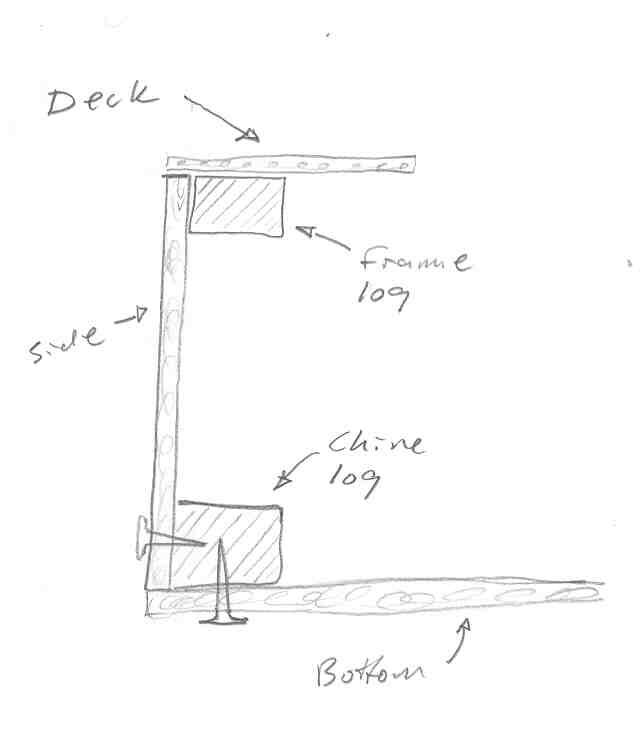
There are a number of ways that you can join plywood together to make right angle joints. The problem is, if you tried to drive a screw into the edge of a piece of plywood, the screw would break apart the laminations and the joint would fail.
One simple method is to use chine logs. First, you attach strip of wood (a chine log) to the edge of the side panel. Then, you attach the bottom to that same strip of wood, and presto the two pieces of plywood are held together in a very strong joint.
The main purpose of the chine log is to have something to drive a nail or screw into, so the chine log only needs to be big enough for that purpose. For instance if you are using 1/4" plywood with a 3/4" (or 7/8") bronze ring shank nail, then a 3/4" square chine log is all you need. If you are using a 3/8" bottom with a 1-1/8" screw, you will want a 7/8" chine log.
The overall strength of the hull comes from the decks, bulkheads and other internal structure parts of the hull. You can use larger chine logs if you wish, the extra weight will not be noticable, but there is not much extra strength if using larger chine logs. There is a bit of a compromise, the larger your chine log, the more difficult it is to bend and match to the edge of your plywood.
Because the hull bottom is the same width as a sheet of plywood, when you attach the bottom, the edges are usually flush and match up. For other parts of the boat like the decks, typically you make the sides with a framing log on the top, then install a bulkhead that has a framing log on top, and the last thing you do is lay a flat sheet of plywood on top as the deck. The edges of that deck piece typically extend a bit beyond the sides and bulkheads, then after the glue is dry you will sand it flush.
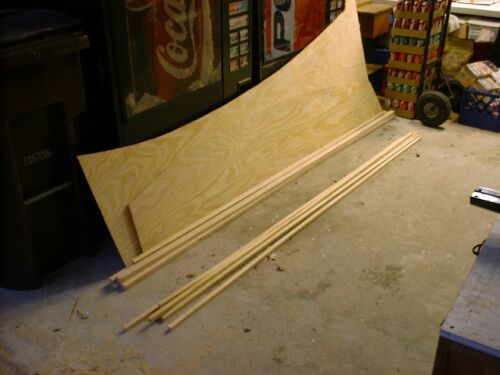
One of the problems when making chine logs, is that 2x4 lumber often has lots and lots of knots. I prefer to use 2x6 or 2x8 lumber because it has less knots.
Often I can't use the entire piece of lumber to extract chine logs, so I will use the boards the best I can.
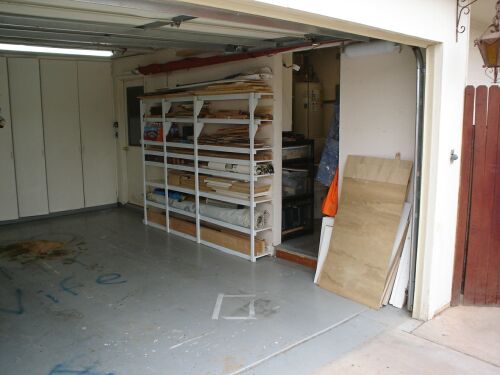
I end up with a lot of odd shaped pieces this way and if they are just layed about, it makes kind of a mess. Also if the boards are left to lean on something, they will start to warp out of shape. This is my current solution to storing wood.
I sort the pieces in various ways so when I need a stick of wood of a certain size, I first go to that shelf and look for something to use. If I can't find it, I always have a number of full size 2x6's on the bottom.
The plywood stands upright in a stack. I don't have a full sheet standing there in the photo, but I can put about 5 sheets there. I don't own a pickup truck, but have found a method to bring home plywood that is SO EASY. I simply trailer my puddle duck to the hardware store and stack the plywood on to of her for the ride home.

Please don't get me wrong, if you want to have a messy garage that is fine. This is my buddy Tim Webber's garage, and he builds as many boats as I do.
He usually builds on his driveway and then puts the parts on a trailer. Then he covers the hull with a tarp and keeps it down the side yard next to his garage. Gotta figure what works for you and your situation.
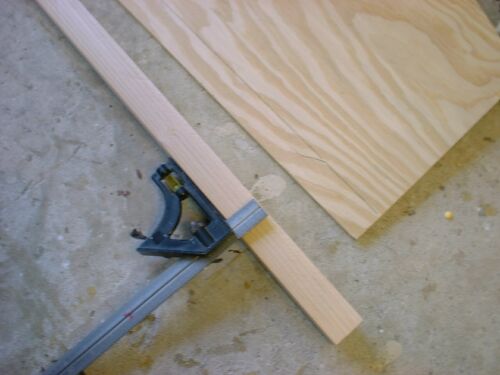
It is really nice to have a guide line so you can see where the log is, to make it easier to drive nails into them. Before nailing on the logs, I mark the sides with a line showing where the log will be.
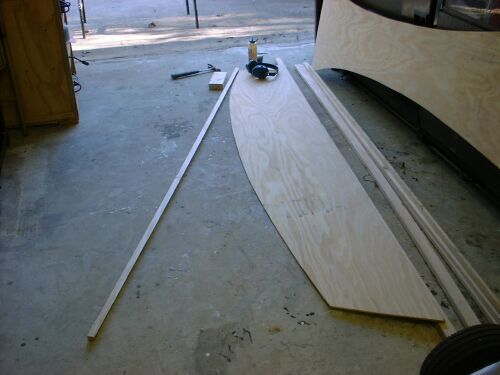
It is easier to start at the stern because that has the most pronounced curve to it. As you move forward, you can use the length of the chine log to bend gently as you go.
50% loss of glue is perfectly acceptable. Use lots of glue, and clean it up afterwards with paper towels. Better to have a little mess, than a joint that is starved for glue.
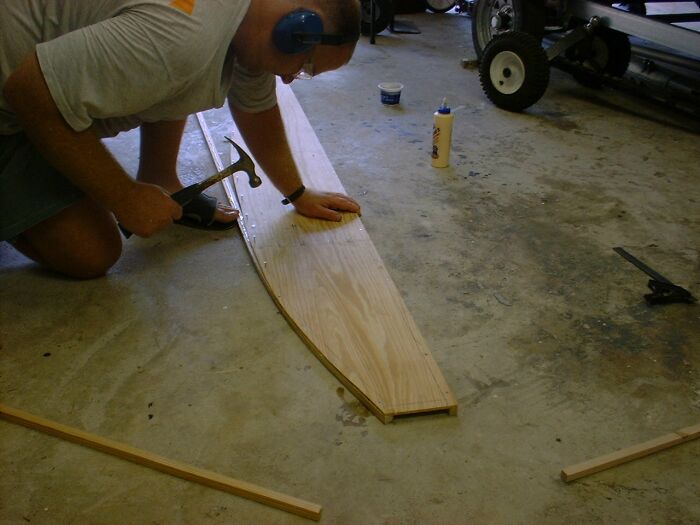
After starting the log at the stern end, it is easy to pull the side towards me as I drive the nails.
It works better if you have the panel pushed up against the wall. At the time of this photo, I had a mess in the garage and couldn't get to the wall.
There is also another chine log laying loosly on the floor underneath the side. That is to support it so that as I drive the nails thru the plywood into the chine log, that they will be straight in.
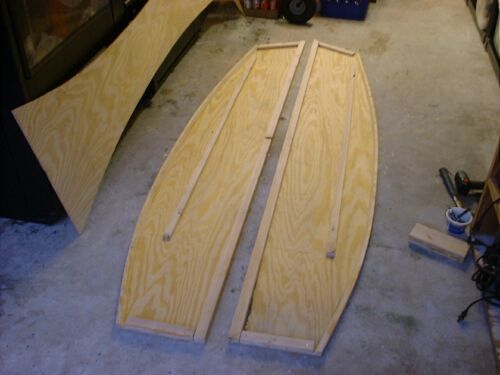
Presto, both sides are framed. The extra stringer down the middle of the panel was to be used for mounting different daggerboard trunks, but I ended up not using the stringer and switched over to a pivoting leeboard.
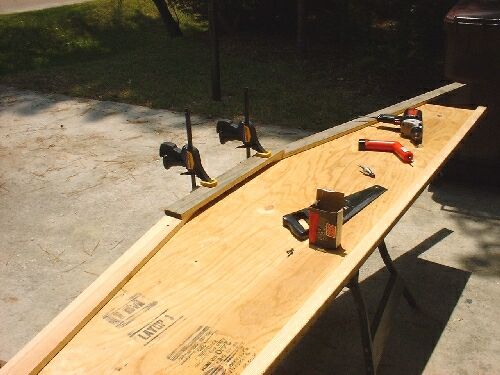
Another method you can use instead of bending the log around, is to put 3 planks along the curved edge. You can then trim them with a saw to get a rough curve, and sand it the rest of the way.
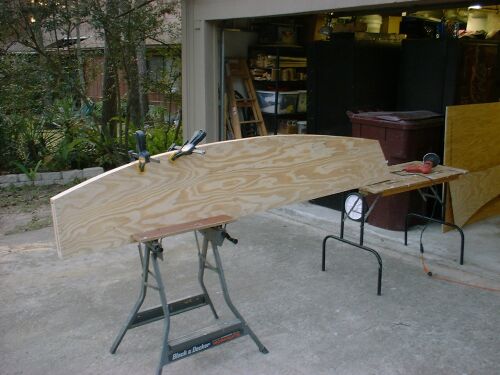
After the glue dries, stand the panels upright and clamp together. You want to make sure that the plywood does not extend beyond the edge of the chine log, otherwise that will prevent the bottom from attaching to the chine log. If there is an obsruction, you can sand them together so you will have a clean join when you attach the bottom.
There are many different power sanders you can use, my favorite is a simple rubber 5" disk that is chucked into my drill, and I always have a stack of sticky backed 80 grit sand paper disks.
After sanding, this is a good time to check your rocker curve to make sure it is class legal. If there is a problem with the curve, this would be an easy time to correct it before going any further. Here is how to measure a pdracer hull.