
Design Considerations Of The Puddle Duck Racer
All boats are compromises, there is no single boat that is perfect for all purposes. When picking a boat to build, you need to think of the end result of how it is to be used and pick the characteristics which best meet those needs. Below are some of the factors which make this type of hull perfect to use for puddle ducking.
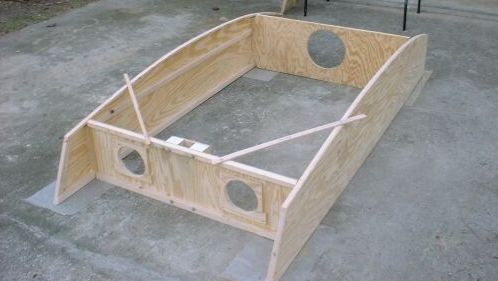
Easy To Build = Easy Get Friends Build Too
Sailing is great, I've been doing it all my life and every time I launch a boat, I get that magical feeling. Sailing and racing with friends multiplies that magic up to an even higher level of fun. So... the easier it is to build a hull, the easier it is to get your friends to build them and come racing with you.
The generic term for a PDRacer is a "box boat" because of the rectangular perimeter. Of all the hull shapes that people use as boats, the box boat is the easiest one to build because it is literally just a box with a curved bottom.
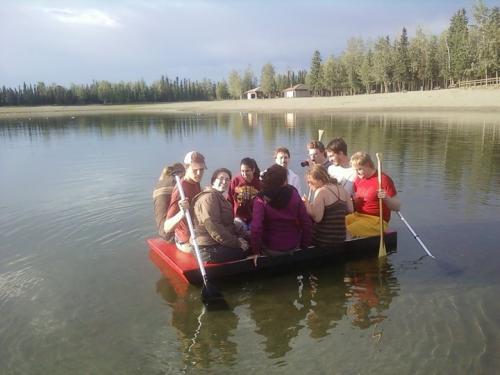
Carry Lots of Weight
Compared to other boat shapes, a box boat type hull carries the most weight for it's size. Easy to understand why because for it's length, it has the most hull area working to displace water which creates the carrying capacity. In contrast if you look at pointy boats that narrow bow doesn't displace much water but does take up length.
Very Stable
They are very stable, as in it is very difficult to capsize. This also comes from the wide hull shape, each side is the full length of the boat and works like a lever arm to keep the boat upright. This menas we can use very large sails, it also means beginning sailors will have an easier time sailing them because they feel less tippy. If you are into fishing, you can literally stand up to cast.
Easy To Configure
Box boats are incredibly forgiving as to how you configure them, the long flat sides sort of work like full length keels helping to track. It is often said that PDRacers sail much better than they should. For configuring where to put the sails and fins, many duckers simply take a guess at what "looks right" and those guesses continually WORK just fine.
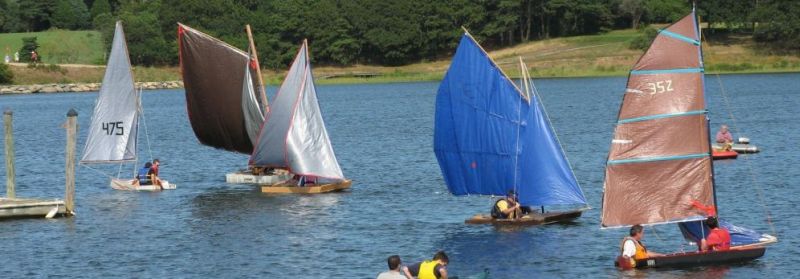
Fixed Hull Shape, Unlimited Sails
Most of the other sailboat classes fit in one of two categories:
- The class keep the boats as identical as possible so that the competition is between the skill of the crew.
- The class competitors engineer completely different sailboats so that their boat design is a significant part of their ability to compete. This category also tends to become a competition of who has the financial resources to gain the best engineering solutions.
Our class fits in an area between those 2 general types. Our racing competition is largely about the skill of the skipper, but also we have the freedom to engineer parts to make our boats go faster. Because we all use a common hull shape and our boat is so small, that imposes a natural limit on the overall cost of our boats so our class will always be within the grasp of an amateur garage level competitor.
The advantages of small and slow
From a class perspective, it really doesn't matter how fast or slow the boat is because the point of a class is to have a common set of parameters to use for creating fair competition. So rather than comparing how fast a duck is to some other boat design, we focus on trying to get our duck to go faster than other ducks. Because of the odd properties of our boat, there are huge differences in the speed that ducks go, depending on how much effort the ducker puts into their boat and training.
Because of the social nature of competing with friends, it really is nice to have slow boats. The course we sail on can be smaller and the duckers who are performing at the same speeds can usually stay within talking range of each other. Just think of all the fun distracting things you can call out to other duckers. If you really want to be funny, carry one of those cone loudspeakers that lifeguards use and/or a duck call that hunters use.
Another great advantage, if we are about to collide with each other, it is easy to reach out and push off the other boat so we don't damage each other.
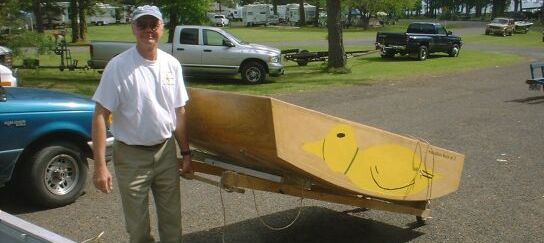
Light and small 8' -- instead of 12' or 14'
Once you discover the boat building hobby and how easy it is to make boats, and you realize that no single boat will be perfect for every situation, you become hopelessly addicted to building boats (just like me). Sounds fun and dandy but after you build 3 or 4 other boats, before starting another project you start to wonder where you are going to put them. Then it becomes an issue of which one do you want to let go, so you have room to build another.
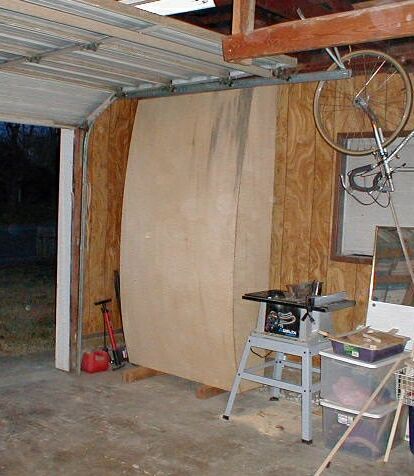
Easy to store when not using her
The puddle duck is just short enough, that she can stand upright against the wall of a typical garage so when you want to work on the next boat, you can just put her there, out of the way. Then your garage floor is completely open so you can build another boat.
I know of one duck that has a shelf that stands inside the upright hull so the space is still functional storage area.
Can cut from single sheet of plywood
Since plywood is typically 8 feet long, all the pieces to make a pdracer hull can come from single sheets of plywood. If you want to make a boat longer than 8 feet, you will need to splice together sheets of plywood for various parts including the bottom. Its not that hard to do, just very convenient not to, have to.
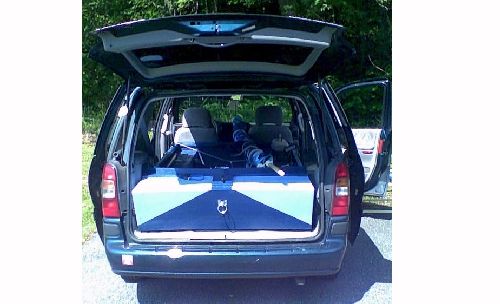
Easy to transport
Hey, look at that, you can carry a puddle duck in the back of a minivan!
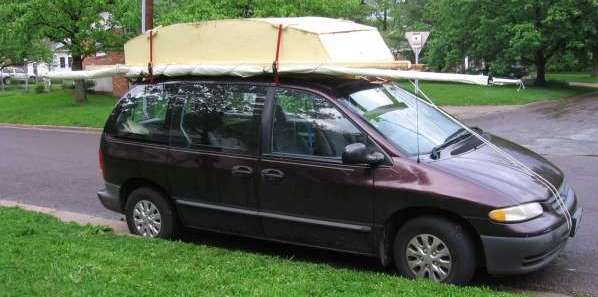
Or on top....
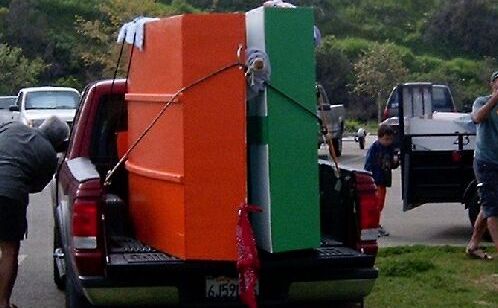
Do you have a pickup truck?
You can carry two at a time!
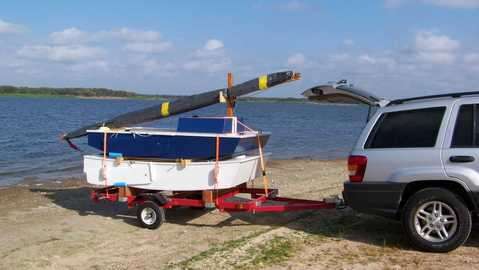
A puddle duck can easily be piggy back carried on other boats, even other puddle ducks.
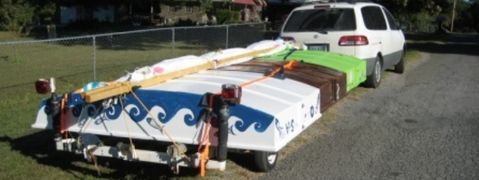
Got a couple of kids and want to race against them?
This is a boat trailer that was converted to carry 3 puddle ducks.
The max width for loads on USA highways is something like 8'6", so the puddle duck is just short enough to be carried sideways like this.
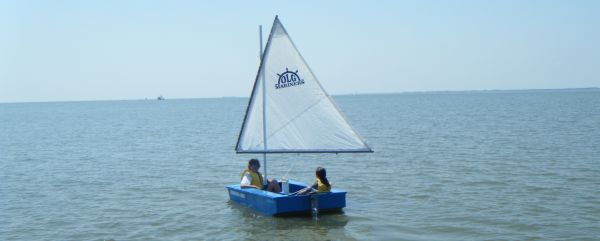
48" wide instead of narrow 32" wide kayak
A skinny kayak type boat is easy to carry around and store but the problem is they only carry 1 person. A big concept of our club is that we are very social, go sailing with others (both in our boats, or in separate ones) and take our kids aboard. Our 48" wide duck can easily carry 2 adults.
For new duckers that have never sailed before, they can invite an experienced sailor aboard to help teach them how to sail. For some duckers this will be their only boat so being able to use as a recreational boat to take another passenger and teach their kids to sail is an important factor.
The Puddle Duck Rocker Shape
Types of rocker shapes
Generally speaking, there are 2 main types of boat hulls: Displacement hulls, and Planing hulls.A displacement hull is like a typical sailboat. It has a curve shape to it's rocker and as you sail, a wave is created, starting at the bow. The harder you push the hull, the bigger the wave gets and the longer it's trough extends. When the trough of the wave extends to the full length of the hull, that is called sailing at the hull's displacement speed.
The most common displacement hull shape has a fair curve and tries to fit that trough so as you sail inside of it, the rocker will match the trough and flow the water around it evenly. A very successful hull shape used for thousands of years, but after you reach displacement speed, the harder you push, the deeper the hull drives into the trough and will be unable to go faster than displacement speed.
A planing hull is shaped like a typical bass boat or jon boat, it has a curved entry and then a long flat run with an abrupt corner at the stern. The way a planing hull works is that as you apply power to the hull, it will create a bow wave just like the displacement hull. However when you apply more power, because of it's flat hull shape, it will rise up on top of the bow wave, and then start to skim on top of water, which is called planing.
The compromise of planing hulls is that if you push it at speeds below planing, then the stern transom will drag in the water and create large amounts of resistance. This resistance is so great, it takes more energy to push the hull at speeds below planing, than to sustain speed after planing.
The Puddle Duck's rocker is a hybrid (semi-displacement or semi-planing) that borrows from both planing and displacement types. It has rounded ends so that it can move through the water at low speeds, but also has a long entry and flat-ish center section. This blended shape allows our hull to travel at both displacement speeds and climb up on a plane to sail at faster speeds.
The hull speed for a boat our size is 4.2 mph. Many duckers have sailed 6.2 mph on a regular basis in reasonable weather conditions. In 2008, Kenny Giles was able to sail his duck at 9 mph (picture on mutton sail page) under wind power alone, which is more than double what the displacement speed is.
Before launching the pdracer class, I spent a year testing the rocker shape on one of my other boat designs. I did not invent this type of shape, it is a technique that has been around for many years and used to great success in the non-foiling division of the Moth class. If you are not familiar with their class, they are sort of the opposite of us, they use the exact same sail and then build different hull shapes.
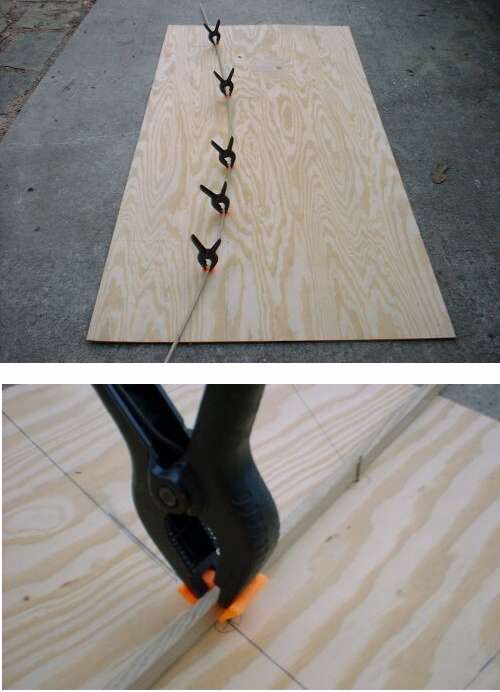
Marking The Cut Line
To create the hybrid rocker shape, the bends from 2 curves were combined. For marking up plywood to cut the rocker it is very simple, drive a nail at each station mark and bend a batten around 3 or more station marks. Or you can bend a single long batten around all the station marks at the same time and clamp them in place as shown in the picture to the right.
NOTE: Measuring for class legal racing, the tolerance range is specified and measured at the 7 station marks so as long as you cross those 7 locations within tolerance, your curve will measure just fine.
For CAD drafters that draw the rocker on a computer, it can be frustrating if they don't understand that the rocker is a hybrid and try to draw it using a single arc spanning from bow to stern. Because of the blended curve, the computer will not draw it properly with a single curve.
The Flat Spot
Because we only have 7 station marks and station dimensions at 3 and 4 are both at zero, that area has been nicknamed "the flat spot". As you can see from how to cut the curve, there is no actual flat spot.
If you did try and make that area perfectly flat, when adding the plywood to the bottom it would not lay flat, instead it would bend to a curve so trying to make a flat spot on purpose would be rather difficult to accomplish.
Bottom line
Really doesn't matter what the hull shape is, the concept of our class is that we all use the same hull shape and then modify the other parts to make them go as fast as we can. Here are some tips to make your PDRacer go fast.
In early 2010, we discovered a few people were intentionally modifying the rocker shape beyond our tolerance range. To resolve this issue we now measure hulls for racing (more info) to confirm participating hulls are class legal so there is no question as to whether anyone is cheating and to preserve the integrity of our racing class & the duckers who participate in serious competitions.