
Make your puddle duck go fast
The PDRacer is very cheap, quick & easy to build and sail. When it comes to racing, our competitions are more challenging. The reason is we have an odd type hull that has different sailing properties than a typical sailboats and developmental rules with the freedom to build many different types of sail rigs and fins. To do well in our races, you have to develop your sailing skills, boat building skills, and figure what it takes to compete with your local duckers.
Boat Engineering
Build Her Strong
Because our boat is a scow shape, she is a very stable hull, which means we can fly much larger sails than other typical boats our size. Combine that with racing where everything is stressed to the limit, the loads our boat will see are much greater than you will typically see in other conventional boats. If you want to finish the race, you gotta keep all your parts working, so build her with strength in mind.
Properly shaped sail
Sailing across the wind is pretty easy and usually the bigger the sail the faster you go. The reason it is so easy is because you can rely on the pushing effect on the aft side of the sail. Sailing to windward is more difficult, and that is why most race courses put a buoy straight up wind. The windward leg of the course is usually the place where the winners and loosers are determined.
The airfoil shape of your sail has a lot to do with how well it performs when sailing to windward. As for what is the optimum airfoil shape, that depends on type of sail, wind speed, and other factors. I have a general rule of thumb on the sail shape page.
The better the shape of your sail, the higher you can point into the wind -- which after you do the math, you can see that pointing just a degree or two higher than your competition can allow you to arrive at the windward buoy quicker.
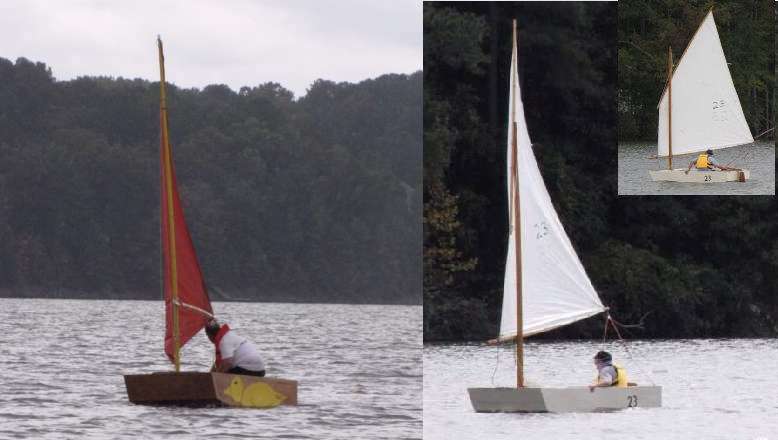
3 Sides sails -VS- 4 Sided Sails
3 sided sails like mutton and lateen sails are able to point much higher into the wind than 4 sided sails. Most of this performance advantage is because 3 sided sails can retain their airfoil shape when pointing into the wind, the airfoil shape produces lift.
The problem with 4 sided sails is they have a lot of twist in the upper portion of the sail which ruins their airfoil shape, so while a 4 sided sail may have more square area, it has less power when sailing to windward.
In the picture, both pdracers are sailing as close as they can to windward. The red sail is a mutton and you can see that the sail is holding it's airfoil shape along the entire luff (forward edge) so most of that sail is working and producing lift. The white sail is a 4 sided balanced lug and you can see how much twist there is, much of it's airfoil is lost. For comparison, the inset picture shows the same lug sail heading across the wind on a reach.
Our races have repeatedly proven the success of 3 sided sails. Lots of small local races, but most notably at our 2011 championship, Scott Widmier used a (3 sided) windsurfer sail and won each of the races he entered while competing against balanced lug sails skippered by experienced racers. Scott did break a mast and placed lower on points, but the performance of the sail was clear. At our 2012 championship, George Uehling adapted a (large 3 sided) Laser Sail to his duck and won.
Stiff Mast and Spars
The sails are attached to the mast & spars to hold the shape of the sail and the above paragraphs explain how important it is to retain the proper shape to our sails. Masts are often tapered to reduce weight aloft, but a problem is that if the masts are tapered too much, they become too bendy and flexible. When a nice gust of wind comes along, we hike out and try to utilize that extra burst of power, and what does our mast do? It bends and destroys that nice airfoil shape and spills all the good power that mother nature just handed to us. The stiffer your mast & spars, the better your sails will perform.
Rotating mast with teardrop cross section
The mast is right there in the front of the sail, so having a mast shape that doesn't mess up the wind is important to laminar air flow. Marchaj discovered through wind tunnel testing that a 3:1 teardrop shape is the optimum mast shape. This teardrop shape must rotate so it is oriented towards the flow the apparent wind. If you want to see a prime example of this type of mast, look at a Hobie 16. You can also create the teardrop shape by using a sleeve type sail. Laser sailboats have round masts with a sleeve luff which the sleeve is just the right size to form the teardrop shape.
Fin Cross Section Shape (Fin = Foil, the Leeboard and Rudder Blade)
A lot of hype surrounds foil cross section shapes, but in real life the difference in performance between shape 3 and 4 on the keel page is so small that it is considered insignificant. You are welcome to experiment with different shapes, VMG testing can reveal if one shape is better than another.
Fin Perimeter Shape
The perimeter shape of the foil has a significant impact on the drag created by the fin. A tall skinny blades that is mounted so the long dimension is held vertically, are called "high aspect" fins. Examples of high aspect fins are daggerboards and pivoting leeboards. A fin that is mounted so the long dimension of the board extends horizontally is called a "low aspect" fin. An example of low aspect fins are bilge boards and shoal keels.
For the same underwater square area, a low aspect fin will create more drag (make the boat slower) than a high aspect fin. Another issue with low aspect fins is they make the boat harder to turn, which leads to stalling & ending up in irons as you tack and cross through the wind.
Fin Location (centered, offset, or side)
I know it looks strange to have your main fin (leeboard, daggerboard etc) not in the center of the boat, but it really doesn't make much of a difference when put over on the side. There are problems with having the daggerboard in the middle, it gets in the way and many ducker complain about banging their knees on it.
Fin Balance - Placement Fore & Aft
Your leeboard (or daggerboard, or whatever) needs to be located in the proper location to balance with the sail rig you are using. If they are not balanced, the water will not flow past the board properly causing vortexes to swirl around your board, and causes drag. There are many rules of thumb of where to place the board, but since most of our sails are custom built, the sail doesn't always end up the exact size of the drawing so you really need to go sailing in your duck to test & adjust your board to get it to balance properly with your sail rig. One of the neat things about the pivoting leeboard is you can adjust them by tilting to get the perfect balance.
Fin Size - Underwater Square Area
If you watch highly competitive dinghy racers, they hoist up their main fin when heading down wind. This is because the underwater portion of the fin creates drag. The same concept is true when sailing to windward, if you build a leeboard that is too big, then you have some extra drag that you could eliminate. But if you make your leeboard too small, then as you sail to windward, it won't provide enough lateral resistance and your hull will slide perpendicular to the direction you are trying to sail.
Generally speaking for the average sail used on a duck, the underwater portion of the fin should be about 3 square feet. The bigger the sail you use, the larger the effort it produces, so you will need more lateral resistance (a bigger fin).
One way to see if your main fin is sized properly, is to perform the following test to observe how much it will slide across the water as you sail to windward. You need a compass and some shore line.
- Go sailing in a patch of water that doesn't have tides or flow
- Sail close to the wind and note your compass course
- Sight along the gunnel and look at where it is pointing to on the shore
- Hold your compass course for 1 minute
- Sight again along the gunnel and look at where it is pointing to now
The difference between the first sighting and the second sighting will be the amount of slide per minute that you have with that combination of sail and fin. Now swap to a different fin and go test that one. If the bigger board has less slide, then use the bigger one because it will give you better VMG. If the smaller board has the same drift as the bigger one, then use the smaller board because it will give you the same VMG with less drag.
Hull Weight
Intuitively you would think that a lighter hull would make a faster boat, but in reality it isn't that simple. Most duck hulls are around 125 pounds when fully rigged, some have been made as light as 40 lbs, and some up in the 180 or 200 lb range. The biggest variable is actually the crew weight. Some duckers are tiny little people barely weighing 80 lbs, while some are big people like me in the 300+ pound range, but most fit somewhere in between.
In light winds, because of my size, I can almost guarantee that I'll loose a race. But as soon as the wind picks up to 10 mph or better, then I have a significant advantage. Being heavier allows you to more smoothly control the boat, and also when hiking out I can apply much more pressure keeping the mast upright, so I can extract more force from the wind, making me go a lot faster.
Sailing Skills
Racing Experience
All the talk in the world and chat on the internet is nothing compared to simply getting out there and racing. The more you race, the better you will get. Lucky for you, we have an open membership list so you can directly contact any other ducker and setup time to get out there and go do some racing.
Doesn't need to be formal racing, just twist their arm to go sailing and setup a practice race course. Get a couple of empty milk jugs, piece of line and brick for an anchor. Make it a small course with one buoy straight up wind from the other one. One of you blow a whistle to start the race and do a single lap up to the windward buoy, then back to the leeward buoy. After that one lap, talk about what went right, what didn't go so well, and then try it again.
After you get some real world experience racing, there are many books about sailboat racing that will help you understand it better and help to improve your racing skills.
Learn to read the luff of the sail
Sails work with the principle of laminar flow and a combination of lift on the windward side, and push on the aft side. You need to learn to look at the sail, and evaluate how the wind is flowing around it.
- Pull the boom so it is above the stern corner of the hull
- Sail about 60 degrees off the wind. The luff of the sail will be very full looking, like a t-shirt pulled tight over a fat man's belly.
- About every 20 seconds, turn a degree or two higher into the wind and then continue on that course.
- Watch the luff of the sail, at some point the luff will collapse, this is the point you have lost laminar flow.
Generally speaking, you want to keep pointing your sail just below where the luff collapses. This is where you will be pointing high into the wind but still getting good lift from your sail.
Reading the luff is just the first step to keeping the air in laminar flow over your sail. After you get good at reading the luff, you can do extra stuff like attach bits of yarn to your sail (called tell tails) that can show you more about how the wind is flowing over your sail.
Sail tension
Each type of sail requires a certain type of tension to make them perform properly, so you need to study what makes each sail work best. I have some good books that cover this subject listed on the sailing books page. The tension they need changes depending on the wind strength & course you are sailing. Some racers use a variety of cam cleats with all control lines in one area, so they can quickly change tensions of various parts.
Figure the best VMG for your sail rig
Most race courses have a buoy directly to windward, but we can't sail directly towards it, we can only sail at angles towards it. Now here is the problem -- the higher you point into the wind, the slower your boat goes. There is a concept called "VMG", which means velocity made good, it is the angle you are sailing, combined with the speed your hull is moving to determine how fast are you closing in on the windward buoy.
Because we custom build our boats with lots of different parts, you need to get out there and measure the performance of your duck and do the calculations to determine what angles are the best to sail at to climb towards the windward buoy. You will need three things: compass, gps, wind meter.
- Go sailing and find a patch of water that doesn't have trees and stuff obstructing the wind and doesn't have tides or flow.
- Start sailing in a direction and trim the sails & other adjustments to get the best speed at that angle.
- Write down the compass heading and the speed, then turn straight into the wind.
- When your boat is pointed straight into the wind, take another compass reading which tells you what angle you were sailing at.
- When the boat stops moving foward, measure the wind speed.
Keep doing this at different angles off the wind and get a variety of measurements. You can then take this data back home and calculate which angle and speed will give you the best VMG towards the windward buoy.
There is another neat benefit of this process, it allows you to compare many variables in your boat. For instance lets say you build a 2nd sail rig and you want to see how it compares against the first one. Take a set of VMG measurements using the first sail, then switch sail rigs and take another set of measurements. Because you are recording the wind speed, angle off the wind and boat speed, you can have an accurate measured comparison of one sail rig to the other.
Read The Course
Racing sailboats is more of an art form that is supported by science. Your situation on the course will be continually changing due to many factors, and the more you race, the better you will get at reading the situation and coming up with productive actions to take. There are many books about sailing and racing that discuss this subject which is a great place to start, and then contact other duckers to learn from seasoned racers. And then go practice, race, practice and race some more.
Learn to read the wind and how it shifts
The wind is constantly changing direction, some times it will help you, sometimes it won't. The wind will make marks on the water that you can read, and also natural obstructions along the shore will create certain predictable wind conditions if you sail near them. So you have to read and predict how the wind conditions are going to change and how that will help or hurt your position.
Sail The Hull Flat
Flat bottom hulls perform better when they are sailed flat, as in level fore and aft, and from side to side. This is something that has been proven amongst many other boat classes, so much that there is an entire book written about the subject called "sail it flat". See the racing section in the sailboat book pages. Our puddle duck having a flat bottom, performs best when sailed flat.
Don't Drag The Stern Transom
When travelling at displacement speeds, you do not want to drag the stern transom. You need to adjust your position in the hull so that the stern transom is not dragging through the water. If it does drag, it will create vortexes which create lots of resistance to the hull moving forward, even though the vortexes themselves are aft of the hull.
Prevent Pig Rooting
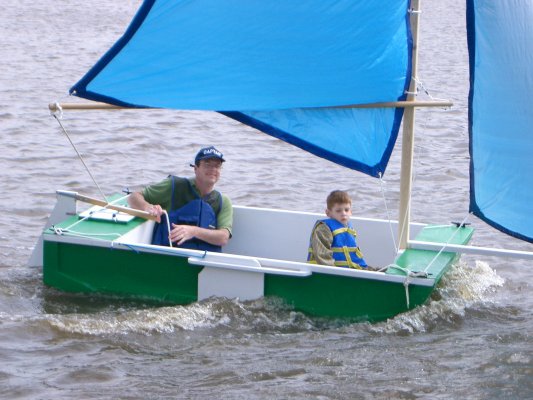
I know it is a goofy name, but it is very descriptive. You know how a pig will dig with it's nose looking for roots to eat? That is what it looks like if you don't balance your weight properly when driving the hull really hard.
We use really big sails and when the wind is coming from the stern, the big sail & mast acts like a lever arm and pushes the bow down into the water. If you find yourself doing this, it's not alarming, it just feels like someone is pushing on a brake pedal that you didn't know you had.
To fix it, adjust your weight aft to take advantage of the extra wind power and get up on top of the bow wave so you can plane at higher speeds.
Or you can ease your sail to dump the wind.
Or you can just plow around some water and wait for the wind to ease.
Planing Your Hull
When the wind kicks up above 12 mph, you will get to play in a fun area of difficulty with the 2 above issues of pig rooting and dragging the stern. With those two hindrances, even though you have more wind, you might actually go slower than if you had less wind. If you balance the hull properly, you can transition to planing and jump up to 6 mph (or faster). It takes practice, but if you get good at it, during a race you can take advantage of that situation and pull ahead of the competition, leaving everyone else wondering how in the heck you broke free while they are stuck plowing around water.