
Rule 1 - Rocker Shape
Is it class legal to alter the rocker shape a little bit to make it better?
No - Intentionally modifying the rocker shape is prohibited. Please read the top of the class rules page where it has always said, we all use the same shaped hulls and modify the other parts.
Is the "defined hull shape" shown on the top of the rules page the shape that you cut?
Or is it the final size of the boat?
The defined hull shape (DHS) is the perfect shape of a finished PDRacer, however most of us use that as the cut plan for our side panels and then add plywood to it. The tolerances are setup loose enough so that you can use it as a cut plan.
Is the boat measured before or after the bottom is attached?
Measuring to see if the hull is class legal is performed on a finished boat.
Are the end points (where the bottom meet the transoms) movable within the tolerance?
First you must understand that the line between the end points creates the base line which all other tolerances are measured from. This is the only thing we can use as a base line, we can't use the edge of the plywood we cut the panel from, because that edge is now gone, and the top sheer lines of all our boats are different. So rather than questioning if the line is within the rocker tolerance, you need to understand that the string line defines the rocker tolerance area. And that tolerance area is shaped like the mouth of a "smiley face".
If I just made a 10" high hull, could I extend the corner of the bow chine forward ?
No - The lower 10" of the hull must conform to the same shape as a boat built with the exact same 18" high defined shape, which includes the bow angle. See the essay on how to cut the bow angle.
Is there a flat spot in the rocker, between station 3 and 4 ?
Rule 1F says the rocker must be a curve, so why is it flat between station 3 and 4 ?
When you attach the plywood to the bottom, it takes whatever you have and smooths it out to a curve so realistically, it would be very difficult to create a true "flat spot". Also understand when determining if the hull is class legal or not, it is only measured at the 7 station marks. So as long as you make sure to cut accurately in those 7 locations, your hull curve will turn out just fine.
The point of rule 1F is to eliminate weird shapes between the station marks. Weird shapes like steps, bumps or some other unforeseen shape.
Another thing you might want to know, is that our curve is not a natural bend from bow to stern, it is a hybrid made by combining 2 batten bends. You can read more about it on the page: Designing The Puddle Duck Racer
Is it class legal to sail a hull Upside Down?
No - if you turned it upside down, the top would then be the bottom and required to match the other boats. Same restriction would prohibit a boat from being sailed on it's side.
Rule 2 - Flat, Parallel Sides and Transoms
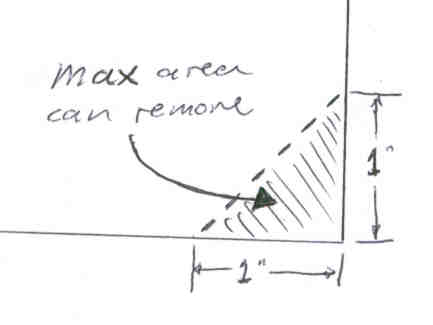 Explain the rounding more - is that the radius of the router bit?
 The 1" chine removal allowance is really more like a fillet. The drawing to the right shows what can be removed. This rule is intended to allow for fiberglass hulls to be molded, they need rounded corners rather than sharp ones.
Is it OK to mount a rub rail on the sides below the 10" line?
Yes, as long as it does not violate the fin width tolerance. It would the same as attaching a fin to the side of the boat as allowed in rule 6, think of it as a leeboard permanently attached in the up position. This also allows you to use external chine logs as long as the logs do not violate the fin width tolerance and the flat surface of the sides are still within the hull width tolerance.
Is it OK to flare out the hull hull above 10" ?
No - The rule says flat sides, flat transoms. So as the sides and transoms continue up, they must continue to be flat. If you flared the sides out, that area which flares out would provide external flotation. During a race, if a boat is knocked over and it had flared sides, that external flotation would make it easier to right and thus be an unfair advantage.
There is a special exemption specified for above the 10" line that is intended to allow external gunnels, small hiking wings and leeboard support structures.
Can I extend decks or cabin forward (or aft) of the hull?
No - Doing so would create external flotation similar to flaring out the hull. However many duckers have cabins or other extensions that do extend beyond the hull for non-racing purposes. It would be simple enough to make the cabin or other extensions removable for racing, or just race like it is with the delayed start.
Is it OK to narrow the hull above 10" ?
Yes - and most of us already do that in the form of decks and cabins on top of our hulls. As soon as you break the plane of the side or transom and turn in wards, all of that is considered "inside" the boat. The flat side rule is intended to prevent you from flaring out above the 10" line and creating external flotation.
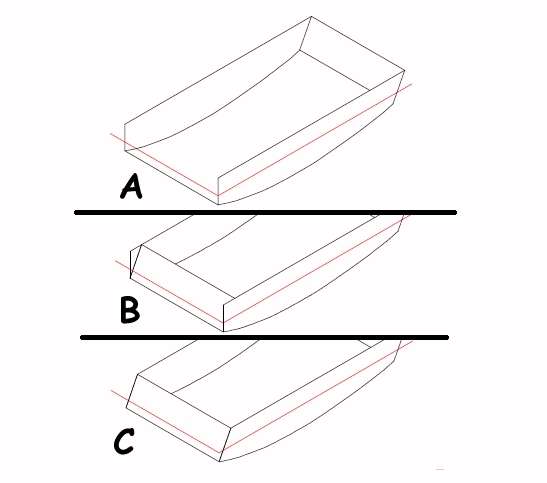 Can I have a stern transom that tilts inward?
 Yes - Rule 2 allows for the stern transom to be partially or fully open, this is to allow for a self draining boat similar to high end racing dinghies. The sides must remain complete up to the 10" line, so the most basic shape that must be conformed to is shown as A in the diagram.
As soon as you turn in wards into the boat, that is considered to be inside the boat. Would be the same as the decks on our airboxes, they are also inside the boat. A stern transom that tilts inward is OK, such as B in the diagram.
The part that you don't want to make a mistake on is trimming the sides to match that inward transom shown as C in the diagram. That would be altering the lower 10" of the sides and is not allowed.
I see the "slots for fins are OK", so can I make a 3 foot wide slot down the middle (and entire length) of the boat?
No - The rule says slot for fin, and the fins have a width tolerance, so the slot can not be wider than that.
Is it OK to have a golf ball like dimples below the 10" line?
No - The rule says the surfaces must be flat. The bottom is curved in one direction, so in relation to the bottom, flat obviously means across the beam. It has been suggested that the grain of the wood has a texture and is not flat, but this is an irritating knit, and if you really want to pick it, no matter how smooth the surface is you could continue down to the molecular level to "technically" prove it is not flat. It is a common sense thing and intentional dimples are not allowed.
Is it OK to have a take apart hull?
Is it OK to have a removable section, so I can drop in a motor or hobie mirage drive?
Yes - If you have a duck that has multiple parts that are bolted together and taken apart (like for for easy transport), then you will end up with a seam. Everyone can recognize this seam will create drag, it is not advantageous to have one. The bolted together shape must stay within tolerance range while used in a class racing. A removable section to drop in a propulsion device would be the same, such as a trunk for a hobie mirage drive.
Rule 3 - Hull Width
I live outside of the USA and am only able to find 1200mm wide plywood (3 foot 11 1/4 inches wide).
Can we make our boats 3' 11-1/4" wide and still be in spec?
Yes - the beam has a 1" tolerance, so the narrowest you can make a boat is 47" wide, and widest is 49", so your plywood would fall inside the tolerance.
Rule 4 - Emergency Flotation
If you capsize and flood the boat, you must be able to self recover it in deep water.
** Please practice recovering your boat, so when the time comes, you will know what to do.
Rule 5 - External Flotation
Are mast head floats permitted?
Yes - And are highly encouraged. They are great to prevent your boat from doing a full turtle and to keep your mast from going down into the mud and possibly snapping off.
Rule 6 - No Lifting Fins & Fin Width Tolerance
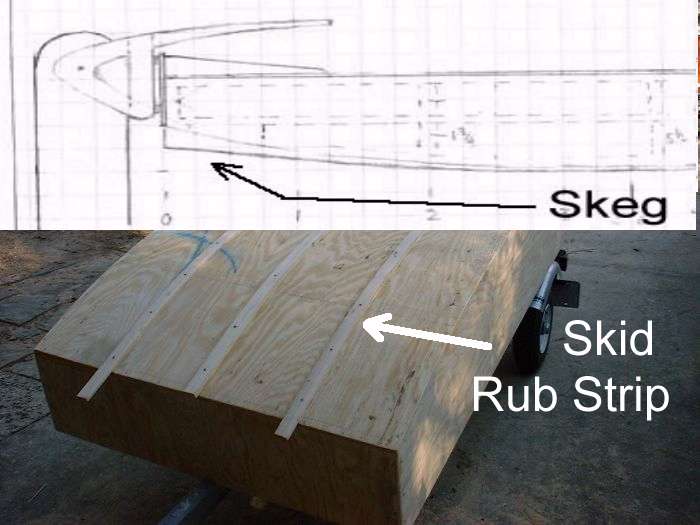 Is it OK to have a skeg on the bottom of the hull?
 Yes - as long as the skeg is not wider than the fin width tolerance. In the simplistic way we view parts of our boat, any object attached to the outside of the hull below the 10" line is considered a "fin". So all of the following objects are also considered fins, the only difference being the name that they are commonly called:
- Rudder, Leeboard, Centerboard, Daggerboard, Keel
- Skid - a small strip of wood attached to the bottom, intended to protect the hull, or stiffen it.
- Rub Strip - same as a skid
- Skeg - a small fin that is fixed to the hull. Most of the time it is in the stern area, sometimes near the bow.
- Shoal Keel - A keel fixed to the bottom of the hull, typically shorter than 12"
- Bilge Keel - Same as shoal keel, but typically shorter than 6"
- Bilge Board - Same as bilge keel
Is it OK to have a skeg extend forward of the hull ?
Is it OK to mount a rudder on a support that extends aft of the hull ?
Yes - Specifically allowed in 6C, fins may extend forward and/or aft of the hull. Most of us already do this, our rudders extend beyond the stern of the hull and rudders are fins. For mounting a fin (such as a rudder) on a support structure, rule 2 has a special allowance for support structures above the 10" line.
Is it OK to have a bowsprit?
Yes, as long as it doesn't violate the fin width tolerance. A bowsprit is the same as attaching a fin to the bow of the hull.
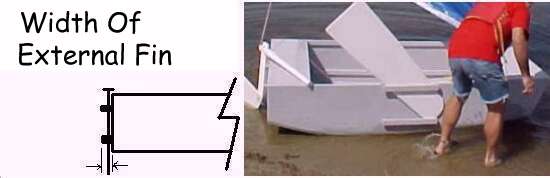 Is it OK to use external leeboards or side daggerboards?
 Yes - fins may be attached to the side (or both sides) of the hull and structures that hold them may be attached there also. The structures holding the fins may be odd shaped and are not required to be flat.
The fin and structures below the 10" line must not be wider than the fin width tolerance.
Structures that are above the 10" line have a special allowance in rule 2. That rule is intended to allow small hiking wings, leeboard guard and other similar support structures.
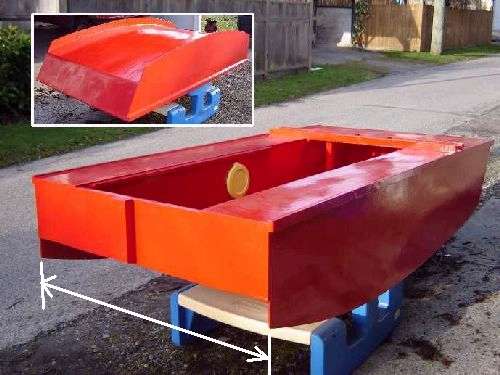
Is it OK to use a full length keel on the side of the hull?
Yes - Full length fins may be attached to one or both sides of the hull. This also creates a small loophole in the overall width tolerance, your resulting hull could be the maximum hull width tolerance plus 2 fin width tolerances. Everyone can recognize that a slightly wider hull will not have an advantage, so is not an issue that needs to be ruled out.
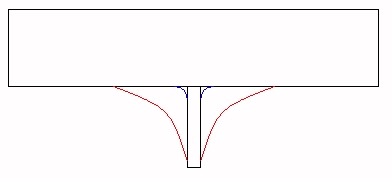 Is it OK to attach a shoal keel with a large fillet
such as the red line in this drawing?
No - The large fillet depicted with the red line would exceed the fin width tolerance.
Is it OK to have more than one keel? Such as 3 shoal bilge boards?
Can I bolt 2 keels together?
You may have multiple fins. If you attach 2 or more fins together, they become a single fin, and the combination of them together must fit within the tolerance as if it were a single fin.
Is it OK to put a box keel on the bottom?
Is it OK to have a foam filled keel?
As long as the fin does not exceed the fin width tolerance, it is OK to have it made from foam, be hollow or other low density construction. Technically that type of fin is less dense than water and it will provide a small amount of lift, but realistically that amount of lift is so small it doesn't matter.
Is it OK to have canting or angled keel(s)?
Is it OK to have a winged keel? Bulb? End plate?
No - all fins underwater must be vertical. Anything besides vertical would provide lift and be considered a lifting fins, so they are prohibited. This applies to the sides of the fins, the cross section of a fins have all sorts of shapes, many resembling a teardrop such as a NACA foil.
Rule 7 - Don't screw with the hull shape
Not Class Legal At Race
I suggest that duckers measure their own hulls before attending events, that way they know if they are class legal. Either way Rule 7 provides that if a boat is found not class legal it will not appear on the score card but may still participate with the delayed start penalty.
Trophy Exchange
All duckers that attend an event with a PDRacer, regardless of being class legal or not, should participate in the homemade trophy exchange. The trophy is a token showing up that day to enjoy sailing with you friends, the score is the competitive placement.
Miscellaneous
Class Rules VS Right Of Way Rules
The PDRacer class rules govern the hull shape and a few other things, not the racing rules (right of way rules). The ISAF (sailing.org) is often considered the main authority for determining the right of way rules. We are not affiliated with the ISAF so we are not required to use their rule set.
We remain a recognized class with our handicap even though we don't use the ISAF racing rules, this is because there is no correlation between handicap ratings and the right of way rules or ISAF affiliation. By the way, our handicap rating is where the "PDR" nickname comes from, our full rating is: PDRacer, All Rigs PDR D-PN: [140.0]
There is a copy of a simplified rule set at the conventional buoy racing page. Many clubs create their own simplified versions so look around if you want to see what they are like.
Special Restrictions (limit to polytarp sails, control hull weight etc..)
There are many suggested ideas for rules such as to limit duckers to only handmade polytarp sails, add weights to the hulls so everyone sails the exact same weight boat, etc etc... Those rules would be administered by the race organizer and would apply to the events that the organizer is in charge of.