|
PDRacer.com |
Puddle Duck Racer Cheap, creative, and having fun on the water. |
What is a Puddle Duck Racer
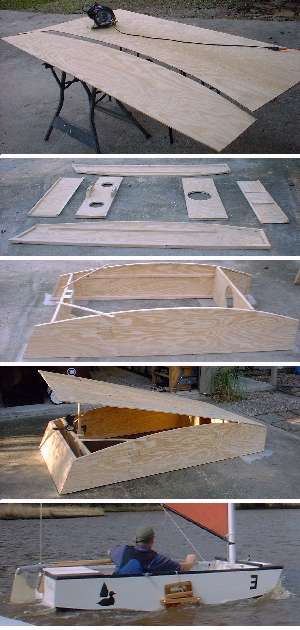
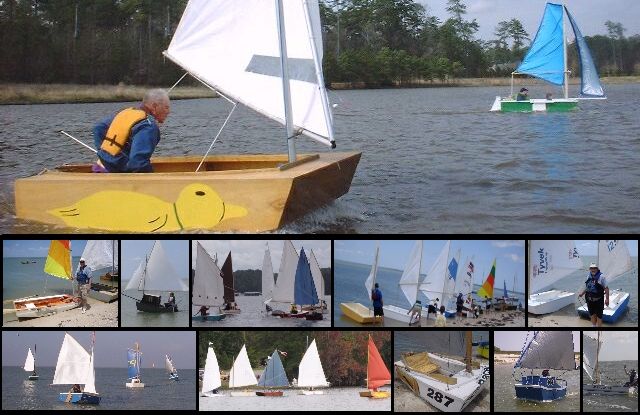
The PDRacer is a developmental one design racing sailboat that is basically a plywood box with a curved bottom and is the easiest boat in the world to build. The rules are aimed at keeping the lower 10" of all hulls the same but the rest is up to the builder. A simple hull can be made from 3 sheets of plywood, titebond II glue and latex house paint. If you work hard for 2 weekends you can go sailing on the 3rd weekend. If you are really in a hurry it is possible to go from lumber to the lake in 5 days. Here are our free plywood sailboat plans
What our club is about
Our club is not about the boat, it is about the people and what we do is described right at the top of this page in our motto. We use the same shaped hulls and go play with them together in fun ways and also for serious racing. We have a handicap rating so we can race with other recognized racing classes. Membership is free, any puddle ducker can organize events (there are no restricted territories). We have an open member list so any ducker can directly contact another. Here is why the hull we use is perfect for puddle ducking: Design Considerations Of The Puddle Duck Racer For more information about what a great community activity the PDRacer Class is, see this newspaper article. In addition to conventional racing we have a big list of fun sailboat games and races.
Interesting Niche Racing
Most of the other sailboat classes fit in one of the two basic categories. 1: One Design where the class keep the boats as identical as possible so that the competition is between the skill of the crew. 2: Developmental class where the competitors engineer different sailboats so that their boat design is a significant part of their ability to compete. This category also tends to become a competition of who has the financial resources to gain the best engineering solutions.
Our class fits in an area between those 2 general types, we are a "developmental one design". Our hulls are a fixed one design shape, the sail rigs and fins are open for development. The result is our racing competition is blend of both the sailing skill of the skipper AND boat engineering & building skill. Because our boat is so small, that imposes a natural limit on the cost so our class will always be within the grasp of an amateur garage level competitor.
Getting Started On Your Duck
You don't need permission from headquarters, just build your duck, contact other duckers to get out there & do our motto !! If nobody else is organizing events in your area, then stand up and take the initiative to organize a local fleet and make the magic happen !!
Free Plans
Site Map - All Pages On This Website
Subscribe PDRacer Newsletter
Contacting Other Duckers
Many Other Uses
Our boat is not just for racing, she is great for all sorts of other purposes and in most states a boat this small does not need to be titled or registered. The hull shape carries 630 lbs. One member took 2 adults and 3 kids for an afternoon sail. Another went on a 3 day cruise with his wife and slept aboard at anchor every night. If you think about it, many people go backpacking for long periods, a PDRacer can hold much more gear and water than a backpack. She also works good as a row boat and motor boat. free plans diy boat oars
I often take my kids out rowing in mine, instead of a sail rig I put a big beach umbrella in the mast sleeve so they can sit in the shade. If you like fishing, you can row her into the shallow areas that power boats can't get to and launch in areas that don't have a boat ramp. She is very stable, enough that you can stand up and cast.
Which boat to build?
If you just discovered boat building, very soon you will become aware that there are TONS and TONS of different boats you could build. For some odd reason, many sailors think they should only have one sailboat - please realize it is perfectly OK to have several (or many) sailboats at the same time. Consider building a puddle duck to get some experience and have fun sailing with other duckers. The lessons you will learn will give you better understanding of how to build boats and make your next project go a lot faster. The duck is big enough to carry a 2nd passenger but small and easy to store. If you lose interest or don't have time, then stand her upright in the corner of your garage or out back till you get the itch to go sail her again.
Don't know how to sail?
For many people that build ducks, it is their first boat and they don't know how to sail either. Sailing is easy, just point the boat in the direction you want to go, then pull in the sail till it stops flapping. The best way to learn is to have your own boat and take her out on a very light wind day, on a very small lake and give it a try. Take a set of oars, if you can't figure out how to sail back then drop your sail and row back. If you know a sailor then invite them along and they will help you out, the PDRacer can easily carry 2 adults.
Afraid it will leak?
All boats leak especially wooden ones. Just because it might leak, doesn't mean you will sink, that is what the airbox flotation chambers are for. Besides, when you are sailing on a very windy day splashing along you will get more spray water than from any leak. Take along a bottomless chlorox bottle and when the water gets to about an inch deep inside the cockpit just do a couple of scoops to flip the water out.
If you are worried about capsizing, see our info about emergency flotation and recovering from knock down pages. Then go practice capsizing with your duck tied to the dock with a long line. After you learn how to recover from a knock down, you won't be afraid of them anymore.
Afraid it won't be perfect the way you build it?
A big part of puddle ducking is to continually tinker with your boat to improve it. Figure which configuration attracts you the most and start building it. Later if you change your mind, you can reconfigure her or just build another hull and move your parts over. They have almost no resale value so no matter what you do, she will be worth the same.
Club Membership
All you have to do is build (or get) a class legal PDRacer and register her. Registration is FREE and Shorty has tried to keep all other aspects of puddle ducking free, offering free plans and full instructions here on the website and requiring entrance to the world championship be free to any registered puddle ducker and their crew. There are no protected territories and any puddle ducker is welcome to organize events and invite others to go sailing.
We have an open member list, if their email address is listed, that means you can contact them direct for duck related activities.
Hatch Events
Want to increase the number of puddle ducks in your local area? One of the things we do is organize "hatch events". This is where people organize a day (or weekend) to get together and build ducks. Many times these are as simple as having a friend (or two) come over and just try to build what you can with no prior preparation needed or can be elaborate events on a big scale with 15 or more ducks being built at the same time. If you are interested in doing a hatch, consider inviting the other local duckers to come help because we really like any excuse to build another boat or help someone else build theirs. :)
PDRacer Specs:
Handicap Rating: PDRacer, All Rigs PDR D-PN: [140.0]
LOA: Average boat built to 8' long, length depends on side height (see class rules)
LWL: 7'6"
Beam: Minimum of 4'
Hull Height: Suggested size is 16" or 18", minimum of 10" required
Sail Area: 50 to 80 sqft commonly used
Weight: Usually around 120 lbs, depends on construction
Capacity: Hull shape carries 630 lbs (that is when both transoms touch water)
Theoretical Hull Speed: 4.2 mph (3.7 kts) (Hullspeed in kts = SqRt(LWL) X 1.34)
Actual Sailing Speed: Average speed around 3 mph
Maximum Sailing Speed: 9.0 mph
Oarlock Placement: 18" to 30" from stern
Optimum size oars: 6' to 8' long
Minimum functional oars: 54" long
Rowing Speed: 2.5 mph at an easy to pull effort